
Global Coffee Market Size Set to Reach $238.99 Billion by 2031 Driven by Premium Ground Blends and Climate-Resilient Cultivars – Mordor Intelligence
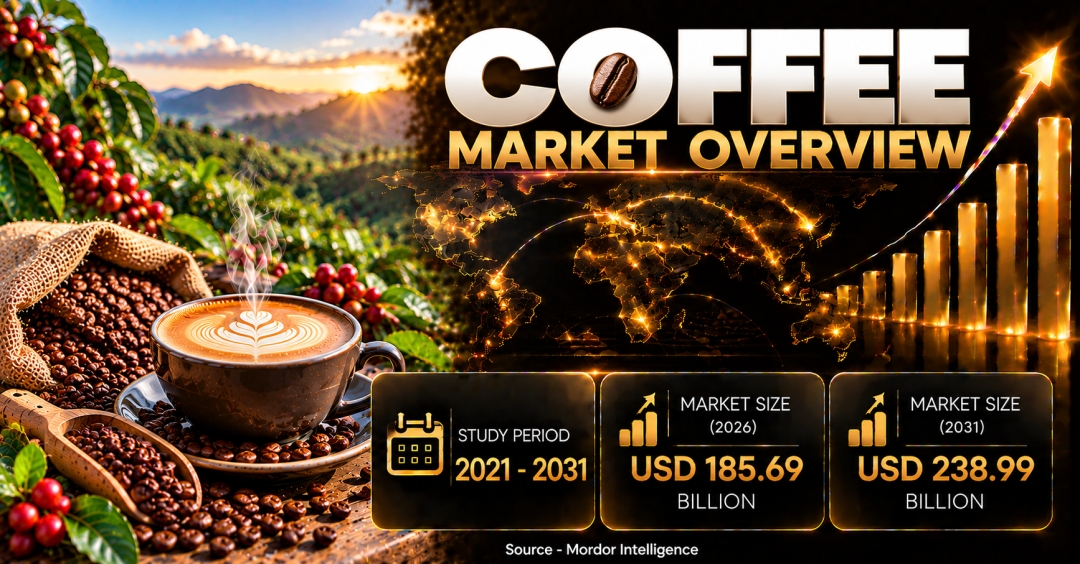
Hyderabad, October 21, 2026: According to Mordor Intelligence, the global coffee market size is estimated to grow from $185.69 billion in 2026 to reach $238.99 billion by 2031, registering a CAGR of 5.18% during the forecast period (2026-2031). The market continues to expand as consumers and commercial foodservice operators prioritize specialty roasts, single-origin bean traceability, and premium café-style beverages at home and on the go. Rising disposable incomes across developing economies, expanding corporate coffee setups, and the increasing preference for convenient ready-to-drink options continue to support demand across retail, hospitality, and digital sales channels worldwide.
The coffee market growth is also influenced by changing international agricultural sustainability mandates and evolving consumer expectations regarding ethical harvest certifications. Commercial roasters and brand owners are investing in farm-level traceability systems, regenerative agriculture programs, and direct-trade procurement models. These operational developments are helping businesses respond to stricter deforestation regulations and supply volatility while maintaining flavor consistency, bean density, and roast profiles. Together, these factors continue to strengthen the integrated coffee market forecast across established and emerging non-alcoholic beverage markets.
Coffee Market Trends
Premium Ground and Single-Origin Coffees Outpace Commercial Blends
One of the leading coffee market trends is the sustained consumer preference for premium ground coffee and single-origin beans. While mixed-origin blends continue to hold the majority baseline share within the coffee market share, single-origin micro-lots are demonstrating rapid value gains. Discerning consumers increasingly value transparency regarding altitude, bean washing techniques, and terroir nuances that produce distinct fruity, floral, or chocolatey notes. Specialty roasting houses and independent cafés are educating consumers through cupping profiles, reinforcing sustained consumer willingness to pay higher prices for distinct flavor experiences. This movement toward elevated cup appreciation continues to support the coffee industry.
Climate-Resilient Arabica and High-Yield Hybrids Address Agronomic Challenges
Downstream agricultural selection remains an essential development area across the coffee market growth. Arabica represents the most widely consumed coffee species due to its mild acidity and aromatic richness, yet it remains vulnerable to climate fluctuations, rising ambient temperatures, and coffee leaf rust. Agronomists and coffee research institutions are developing climate-resilient F1 hybrids and heat-tolerant cultivars like Coffea stenophylla to safeguard production stability. Concurrently, improved Robusta processing techniques are narrowing the sensory gap with Arabica, aligning with broader formulation standards seen across the integrated food ingredients industry for raw material consistency.
Cold Brews and Ready-to-Drink (RTD) Formats Capture Younger Demographics
Format diversification continues to play an important role across the coffee market trends. Ready-to-drink canned cold brews, nitro coffees, and plant-based iced lattes are recording the fastest climb in supermarket chillers and convenience stores. Younger consumers gravitate toward cold coffee formats as refreshing, low-sugar afternoon energy alternatives to traditional carbonated sodas and energy drinks. In response, roasters are adopting aseptic bottling lines and nitrogen-dosing packaging to preserve delicate aromatic volatiles and ensure shelf stability without requiring artificial chemical preservatives.
Digital Direct-to-Consumer Platforms and Subscriptions Expand Retail Reach
Distribution strategies continue to play a significant role in market deployment. Off-trade grocery channels account for the largest share of retail volume through hypermarkets and supermarket shelves, supported by bulk whole-bean bags and ground coffee canisters. Simultaneously, direct-to-consumer online channels and artisanal roaster subscription models are accelerating rapidly. E-commerce platforms allow specialty roasters to deliver freshly roasted beans directly to consumers within days of roasting, supported by automated replenishment schedules and personalized grind size options tailored to specific home brewing equipment.
North America Retains Value Dominance While Middle East and Africa Lead Growth Rate
Regional consumption dynamics continue to influence the coffee market forecast. North America commands the largest regional market share, supported by mature café cultures, high per capita expenditure on specialty coffee drinks, and widespread availability of convenient single-serve formats. Meanwhile, the Middle East and Africa region represents the fastest-growing market, propelled by rapid urbanization, an expanding youth population, and a cultural shift where younger urban demographics increasingly adopt café culture over traditional tea-drinking habits. Evolving modern lifestyle choices continue to create new opportunities for producers expanding their regional presence.
Strategic Financial Outlook: Margins, Upstream Hedging, and Value Creation
From a strategic financial perspective, commercial roasters are shifting capital toward upstream vertical integration to protect operating margins against green bean commodity price swings. Establishing long-term forward contracts and certified direct-trade networks insulates processors from agricultural supply deficits while ensuring pricing stability for higher-margin specialty beans.
Commercial Retail Strategy: Omnichannel Clienteling and Cold-Chain Merchandising
From a retail commercial strategy angle, brand owners are optimizing shelf placement by pairing high-turnover premium ground coffee with grab-and-go refrigerated RTD displays. Concurrently, expanding digital direct-to-consumer storefronts and automated replenishment subscriptions allows roasters to bypass traditional retail intermediary fees and secure predictable lifetime customer value.
Check out more details and stay updated with the latest industry trends, including the Japanese version for localized insights: https://www.mordorintelligence.com/ja/industry-reports/coffee-market?utm_source=abnewswire
Coffee Market Segmentation
By Product Type
- Whole-Bean
- Ground Coffee (Premium Ground, Regular Ground)
- Instant Coffee
- Coffee Pods and Capsules
- Ready-to-Drink (RTD) Coffee
By Coffee Species
- Arabica
- Robusta
- Others
By Origin
- Mixed Origin
- Single Origin / Specialty
By Distribution Channel
- Off-Trade (Supermarkets/Hypermarkets, Convenience Stores, Specialty Stores, Online Retail)
- On-Trade (Cafés, Restaurants, Hotels, and Offices)
By Geography
- North America
- Europe
- Asia-Pacific
- South America
- Middle East and Africa
Competitive Landscape of the Coffee Industry
The coffee industry exhibits a moderate level of market concentration, with multinational food and beverage conglomerates, global roasting houses, and specialized artisan roasters competing across bean origin, roast profiles, sustainable sourcing, and retail shelf space. Market leaders are strengthening their market presence by expanding certified organic and fair-trade portfolios, securing direct farm agreements, and acquiring high-growth specialty coffee start-ups to satisfy changing consumer tastes and international compliance standards.
Supply chain visibility, bean quality grading, and cold-brew shelf-life stabilization continue to be critical areas of differentiation as processors invest in blockchain-enabled bean tracking and automated optical defect sorting. Businesses are also refining distribution partnerships with national grocery chains, institutional food service operators, and major digital marketplaces to secure prime shelf visibility. These initiatives are helping companies protect their coffee market share while maintaining quality consistency across global distribution networks.
Regional expansion also remains an important business strategy. Leading coffee brands continue to build strategic commercial alliances with regional roasters, open experiential flagship café locations in major urban centers, and adjust roast profiles to suit regional beverage preferences. As global commercial demand for convenient, ethically sourced specialty coffee continues to rise, the coffee market forecast remains supported by ongoing investments in agronomic research, sustainable packaging materials, and international brand development.
Key Players
Major companies operating in the coffee market include:
- Nestlé S.A.
- Luigi Lavazza S.p.A.
- The Kraft Heinz Company
- The J. M. Smucker Company
- Starbucks Corporation
Conclusion
The coffee market forecast remains positive as consumers and foodservice operators worldwide continue prioritizing high-quality, ethically sourced coffee that delivers exceptional flavor, daily vitality, and functional wellness. Coffee roasters and brand owners are responding by expanding single-origin and premium ground collections, advancing climate-resilient bean agronomy, and adopting sustainable packaging solutions that balance aroma preservation with environmental responsibility. These developments are expected to support continued demand across multiple retail and on-premise channels.
Regional opportunities also remain strong. North America provides a dependable, high-volume commercial baseline, while the Middle East and Africa offer attractive growth pathways as urbanization and modern café culture accelerate daily coffee consumption. This shift is expected to create new commercial avenues for coffee roasters expanding their operational footprint in developing markets.
Overall, the coffee market size is expected to benefit from changing consumer lifestyle habits, growing demand for specialty and ready-to-drink options, wider availability across digital and brick-and-mortar retail channels, and an ongoing commitment to roasting excellence. Together, these factors are expected to support sustained coffee market growth while strengthening the long-term outlook for the global coffee industry.
Industry Trending Reports
Coffee Pods Market: The global coffee pods market was valued at $15.69 billion in 2025 and is projected to reach $23.03 billion by 2031, growing at a 6.63% CAGR over 2026–2031. Growth is underpinned by consumer demand for rapid, café-grade single-serve brewing at home, alongside willingness to pay premiums for single-origin and certified organic profiles. To align with tightening packaging waste mandates and machine compatibility standards, manufacturers are re-engineering delivery formats around certified industrially compostable materials and barrier-coated recyclable solutions.
Roasted Coffee Market Size: The global roasted coffee market is estimated at $54.62 billion in 2026 and is forecast to reach $72.87 billion by 2031, tracking a 5.93% CAGR. Premiumization is decoupling the sector from baseline commodity cycles, driven by high-end home espresso hardware adoption and expanding specialty café cultures across urban Asia-Pacific. Roasters are securing long-term farm-gate partnerships, farm-level traceability verification, and climate-resilient bean supplies to protect margins against volatile green-coffee price shocks.
Organic Coffee Market Share: The global organic coffee market is valued at $8.73 billion in 2026 and is anticipated to climb to $14.12 billion by 2031, registering a 10.09% CAGR. Accelerated uptake is supported by compliance with the EU Deforestation Regulation (EUDR), expanding on-premise foodservice adoption, and booming direct-to-consumer digital subscriptions. While high-altitude Arabica leads specialty retail, increasing investments into certified organic Robusta across Southeast Asia are reshaping espresso blend formulations tailored for milk-based café drinks.
About Mordor Intelligence:
Mordor Intelligence is a global market intelligence firm, founded in 2014, helping businesses make informed decisions through data-driven insights, industry expertise, and advanced analytics. With 550+ domain experts and on-ground specialists across 150+ countries, the company delivers comprehensive intelligence across aerospace & defense, agriculture, automation, automotive, chemicals & materials, consumer goods & services, electronics, energy & power, financial services, food & beverages, healthcare, hospitality & tourism, information & communications technology, and logistics.
Its offerings include syndicated industry reports, custom research and advisory, and subscription platforms such as Synapse, Data Center Intelligence, and Robotics Intelligence. Mordor Intelligence is ISO 9001:2015 and ISO/IEC 27001:2022 certified, a member of ESOMAR and the Market Research Society of India, and a four-time Great Place to Work® honoree.
Media Contact
Company Name: Mordor Intelligence
Contact Person: Jignesh Thakkar
Email: Send Email
Phone: +1 617-765-2493
Address:11th Floor, Rajapushpa Summit, Nanakramguda Rd, Financial District, Gachibowli [email protected]
City: Hyderabad
State: Telangana 500008
Country: India
Website: https://www.mordorintelligence.com/industry-reports/coffee-market?utm_source=abnewswire


